Controls: Guardrails, Reviewing Controls, and Human Oversight
1. Guardrails
Real-time controls that block known-bad inputs and outputs.
Input Guardrails
| Control | What It Catches |
|---|---|
| Injection detection | Attempts to override system prompt |
| Encoding detection | Obfuscated attacks (Base64, hex, Unicode) |
| PII detection | Personal data in prompts |
| Content policy | Prohibited request types |
| Rate limiting | Abuse, enumeration |
| Length limits | Context stuffing |
Processing flow:

Output Guardrails
| Control | What It Catches |
|---|---|
| Content filtering | Harmful/inappropriate content |
| PII detection | Personal data leakage |
| Grounding check | Hallucination |
| Format validation | Malformed responses |
Limitations
Guardrails catch known patterns. They miss: - Novel techniques - Semantic variations - Context-dependent violations - Subtle policy violations
This is why reviewing controls add a second layer.
See also
For practical implementation guidance, including international PII detection, RAG ingestion filtering, secrets scanning, alerting design, and guardrail exception governance, see Practical Guardrails.
2. Reviewing controls
A second opinion before anything reaches the user: scanners, a semantic firewall, and a model-as-judge weighing the response against policy, context, and intent. This is what catches the subtle failures a fixed rule waves straight through.
The judge is itself a model, so it is probabilistic and can be fooled. It informs the decision rather than making the final call, and it never stands in for the deterministic guardrails beneath it. Treat the reviewing layer as assurance that raises confidence, not as a hard gate your safety case can rest on.
| Component | What it does | Determinism | Typical placement |
|---|---|---|---|
| Scanners | Signature and classifier checks over the response: PII, secrets, toxicity, known-bad patterns | Mostly deterministic | Inline, low latency |
| Semantic firewall | Weighs the response against policy and context, catching semantic violations a regex waves through | Mixed | Inline, low to moderate latency |
| Model-as-judge | An LLM or distilled SLM weighing the response against policy, context, and intent | Probabilistic | SLM inline (~50ms); LLM async |
On the runtime side
Choosing reviewing controls: risk, latency, and PACE
Match the reviewing layer to the risk it guards, the latency the interaction can spend, and the PACE posture you fall back to when part of the layer is degraded.
| Risk tier | Reviewing layer | Latency posture | PACE fallback |
|---|---|---|---|
| LOW | Output scanners | Inline, negligible | Primary scanners; if down, log and serve |
| MEDIUM | Scanners plus a sampled async judge | Inline scan; judge off the hot path | Drop to scanners only; sample later |
| HIGH | Scanners plus semantic firewall, inline SLM judge, async LLM audit | SLM under ~50ms inline; LLM async | Alternate to scanners plus firewall; deterministic block on high-impact actions |
| CRITICAL | Full reviewing layer inline on high-impact actions, plus human oversight | Inline within the action's budget | Emergency: deny the action, route to a human |
The judge informs; it does not hold the line alone. Where latency forbids an inline judge, keep deterministic scanners and the semantic firewall in the hot path and run the judge asynchronously. The control matrix gives baseline depth per tier.
The model-as-judge
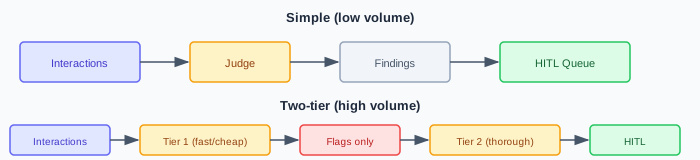
Evaluation of interactions for quality and policy compliance. The judge can be a large LLM (for async assurance and complex reasoning) or a distilled SLM (for inline, real-time action screening). Both can be combined: an SLM screens every action in under 50ms while a large LLM audits a sample asynchronously.
See also
For model selection guidance, see Judge Model Selection.
What the judge does
| Function | Description |
|---|---|
| Policy compliance | Did the AI follow guidelines? |
| Quality assessment | Accurate, helpful, appropriate? |
| Anomaly detection | Unusual patterns? |
| Risk flagging | What needs human review? |
What the judge does NOT do
- Block transactions in real-time
- Make final decisions
- Replace human judgment
- Replace the deterministic guardrails beneath it
The judge surfaces findings and informs the decision. Deterministic controls hold the line, and humans decide actions.
Architecture
Evaluation criteria
| Criterion | Scoring |
|---|---|
| Policy adherence | Pass / Minor / Major violation |
| Accuracy | Verified / Unverified / Incorrect |
| Appropriateness | Appropriate / Borderline / Inappropriate |
| Safety | Safe / Uncertain / Concerning |
Output: PASS / REVIEW / ESCALATE
Deployment phases
| Phase | Action on Findings |
|---|---|
| Shadow | Log only, measure accuracy |
| Advisory | Surface to humans, learn from feedback |
| Operational | Findings drive workflows |
Start in shadow mode. Validate accuracy before acting.
Accuracy
The judge will make mistakes.
| Error | Impact | Mitigation |
|---|---|---|
| False positive | Unnecessary review | Tune prompts |
| False negative | Missed violations | Human sampling |
Target: >90% agreement with human reviewers.
3. Human Oversight (HITL)
Humans review findings, make decisions, remain accountable.
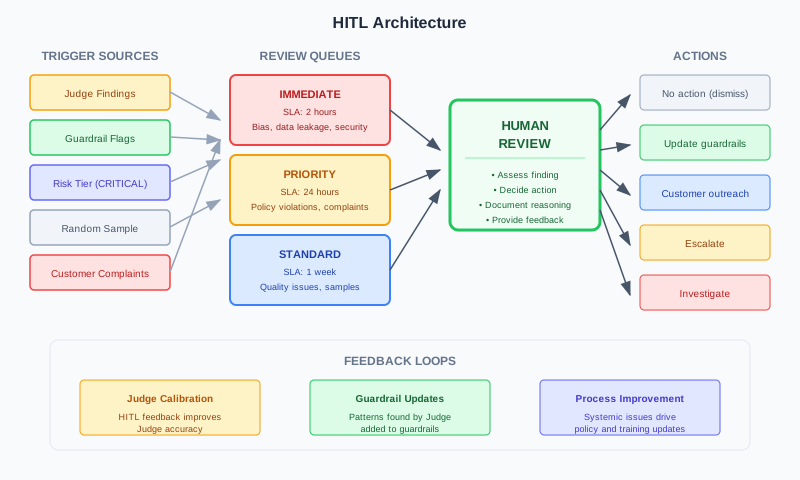
Triggers
| Trigger | Response |
|---|---|
| Judge flag | Review interaction |
| Guardrail block | Review if legitimate |
| User escalation | Human takes over |
| Sampling | Quality assurance |
| Threshold breach | Investigate pattern |
Queue Design
| Queue | SLA | Reviewer |
|---|---|---|
| Critical | 1h | Senior + expert |
| High | 4h | Domain expert |
| Standard | 24h | Trained reviewer |
| Sampling | 72h | QA team |
Actions
| Action | When |
|---|---|
| Approve | Interaction appropriate |
| Correct | Minor issue, fixable |
| Escalate | Needs senior review |
| Block user | Abuse detected |
| Tune | False positive |
Prevent Rubber-Stamping
| Control | Purpose |
|---|---|
| Canary cases | Verify reviewers catch known-bad |
| Time tracking | Flag too-fast reviews |
| Volume limits | Prevent fatigue |
| Inter-rater checks | Measure consistency |
Going Deeper
| Topic | Document |
|---|---|
| What these controls cost in production | Cost & Latency - latency budgets, sampling strategies, tiered evaluation cascade |
| Judge accuracy, drift, and adversarial failure | Judge Assurance · When the Judge Can Be Fooled |
| Practical guardrail configurations | Practical Guardrails - what to turn on first, encoding detection, international PII |
| When HITL doesn't scale | Humans in the Business Process - using existing business process checkpoints as a detection layer |
| Controls for multi-agent systems | MASO (Multi-Agent Security Operations) Framework - eleven control domains, up to 212 controls scaled by tier, for agent orchestration |
| Controls for reasoning models (o1, etc.) | Reasoning Model Controls - trace scanning, instruction adherence, consistency checks |
| Session-level and pre-action evaluation | Output Evaluator - session-aware, pre-action evaluation architecture for agentic systems |
Implementation Order
- Logging - Can't evaluate what you don't capture
- Basic guardrails - Block obvious attacks
- Reviewing controls in shadow - Scan and evaluate without action
- HITL queues - Somewhere for findings
- Reviewing layer advisory - Surface to humans
- Enhanced guardrails - Add ML detection
- Reviewing layer operational - Drive workflows
- Continuous tuning - Improve from findings